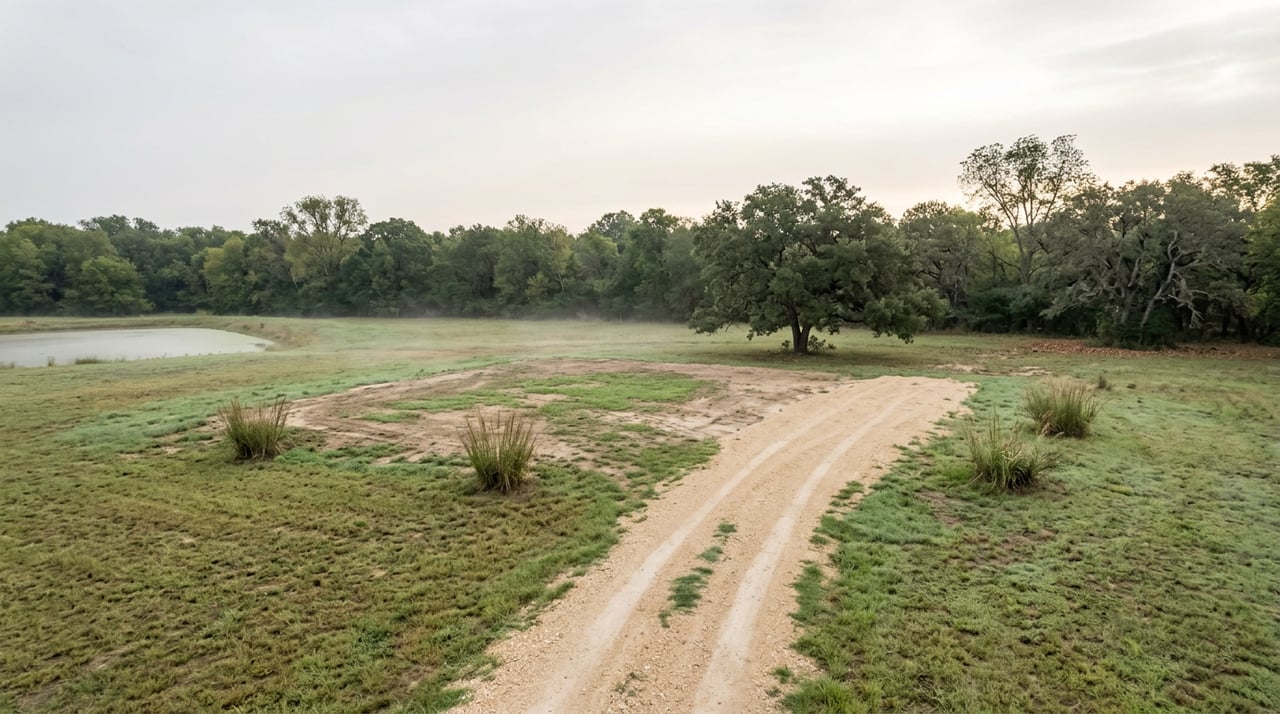
What "Utilities Available" Actually Means on a Hopkins County Land Listing
"Property is sometimes sold with the representation that water is available to the property serviced by this system. Such is not always the case."
That warning sits on the homepage of North Hopkins Water Supply Corporation, one of the utilities most likely to serve a rural tract in this county. A water company felt it necessary to tell buyers, in writing, not to trust what the land listing says about its own service.
That single sentence tells you more about buying acreage in Hopkins County than any price-per-acre figure will. Buyers comparing tracts tend to fixate on the number attached to the acreage, because it is the number the portal puts in bold. But price per acre only tells you what the dirt costs. It says nothing about whether that dirt has a legal, physical path to water, power, and a working septic system, which is the actual question a rural buyer needs answered before writing an offer.
A house inside Sulphur Springs city limits comes with water, sewer, and electricity already attached to the lot. A raw tract in the county does not. It comes with three separate systems, each run by a different entity, each with its own process, and each capable of adding real weeks and real dollars to a purchase that looked simple on the listing sheet.
Here is what "available" tends to mean for each one, and what actually has to happen before it becomes real.
| System | What "available" usually means on a listing | What actually has to happen | Rough timeline |
|---|---|---|---|
| Water | A rural water line runs along the road, or the buyer is expected to drill a well | Confirming the water supply corporation serving that specific parcel will approve a tap, or drilling a well at a cost that runs from roughly $8,000 to $30,000 or more depending on depth and aquifer | Tap approval depends on the system; well drilling depends on driller scheduling |
| Power | The property sits inside a cooperative's service territory | A site visit from a staker, a Field Engineering Report, and payment of Aid-to-Construction fees before a work order is released | Roughly 10 to 14 business days from work order release to construction, after fees are paid and documentation clears |
| Septic | The parcel is described as buildable | A licensed soil scientist evaluation, a permit application to the county's environmental office, and possible review for a 10-acre exemption | Roughly 2 to 6 weeks depending on soil evaluation scheduling |
None of that shows up in the price per acre. All of it shows up after the option period starts.
Inside Sulphur Springs city limits, one utility answers the water question. Outside the city, the county is served by three municipal water departments in Como, Cumby, and Tira, plus ten separate rural water supply corporations. Seven of those rural systems draw exclusively from well water, and North Hopkins Water Supply Corporation, which posted the warning above, is the largest of them.
That fragmentation is not a footnote. It means the answer to "does this land have water" depends entirely on which of roughly thirteen systems happens to serve that specific road. Two tracts a mile apart can have completely different answers, and neither answer is guaranteed just because a listing says water is nearby.
There is a second layer worth understanding if you are looking at land for the long term. County officials recently joined a multi-county Water Conservation Group, formed to protect local rural water companies from outside interests that have expressed interest in drilling large-volume wells into the Carrizo-Wilcox Aquifer, the same aquifer every well in the county taps into. It is a sign that local water systems are watching their supply carefully, which is reassuring for existing customers but also a reminder that a new connection is never automatic. It is a request you make to a specific corporation, not a resource you simply tap into because a line runs past the property.
Farmers Electric Cooperative serves Hopkins County along with eleven neighboring counties in northeast Texas, which is likely the provider for most rural tracts here. Getting power to a new building site is not a matter of calling and scheduling a hookup. The cooperative sends a staker to meet the buyer at the actual site. That visit produces a Field Engineering Report, which lists everything that has to happen before service can be provided, along with a work order number the buyer will need for every future call about the project.
After that meeting, the cooperative sends an invoice for Aid-to-Construction fees, which cover the cost of extending the line to the site. Only after those fees are paid and the paperwork clears does the work order get released for construction, and from that release point the cooperative estimates roughly 10 to 14 business days before the line goes in. That is a real, multi-step process with a real invoice attached, and it starts only after someone owns or controls the land, which means a buyer cannot always get a firm number before closing.
Septic is where the rural process gets the most procedural. Every on-site sewage facility in Texas requires a permit under state rules, and in Hopkins County that permit is administered by Hopkins County Environmental Quality. Before an application can even be submitted, a licensed soil scientist has to evaluate the site, checking soil type, drainage, and water table depth to determine what kind of system the land can actually support.
There is one exemption worth knowing, and one caveat that undercuts it. A single-family dwelling on 10 acres or more may qualify for an exemption from the full standard permitting process. But that exemption still requires a site evaluation by a licensed professional, so it reduces paperwork rather than eliminating the underlying question of whether the soil can handle a septic system at all. Permit fees for a new installation typically run $200 to $500, with the full process, from application to inspection, generally taking two to six weeks depending on how quickly the soil evaluation can be scheduled. Aerobic systems, which are common on tighter or wetter lots, carry an ongoing requirement of three inspections a year from a licensed maintenance provider and a mandatory two-year maintenance contract at installation.
None of this is unusual by Texas standards. It is simply the process, and it means the phrase "septic approved" on a listing should prompt a question about who approved it and when, not an assumption that the work is done.
Current land listings across Hopkins County show a wide range in price per acre, and part of that range comes down to exactly the variables above. A tract with an existing well, an active water tap, and a septic system already installed is not the same product as a tract of comparable size and soil that only has a road frontage and a line running somewhere nearby. Two listings can show the same acreage and a similar asking price while one requires a five-figure well and a multi-week septic permit before it is livable, and the other requires neither.
This is the piece the price-per-acre number cannot carry on its own. "Available" on a rural listing is best read as an invitation to make three phone calls, not as a statement that the work is finished. The water supply corporation serving that road can tell a buyer whether a tap is realistic and what it costs. The cooperative can send a staker and produce a Field Engineering Report before a buyer is under contract, which is worth requesting during a due diligence period rather than after closing. Hopkins County Environmental Quality can tell a buyer whether the tract has an existing soil evaluation on file or needs a new one.
Buyers who make those calls before writing an offer are pricing the actual property. Buyers who skip them are pricing the version of the property described in the listing, which is not always the version they end up owning.
Does every rural water company in Hopkins County pump its own well water? No. Seven of the county's ten rural water supply corporations draw exclusively from wells, while the rest, along with several rural districts, buy treated water from the City of Sulphur Springs under contract.
If my tract is over 10 acres, can I skip the septic permit entirely? Not entirely. A single-family home on 10 acres or more may qualify for an exemption from the standard permitting process, but a licensed soil evaluation is still required to confirm the site can support a system safely.
Who should I call first when I am looking at raw acreage? Start with the water supply corporation that serves that specific road, since coverage is split across ten rural systems and three municipal departments and does not follow tidy boundaries. From there, a call to Farmers Electric Cooperative and to Hopkins County Environmental Quality will tell you what the power and septic timeline actually looks like before you are locked into a contract.
Land in Hopkins County still offers something a subdivision lot cannot: room, privacy, and the kind of property that appreciates in ways a tighter lot never will. But getting there in good shape means treating water, power, and septic as three separate transactions layered inside the real estate transaction, not as details that sort themselves out after closing. If you are weighing acreage in Hopkins County and want a second set of eyes on what a specific tract will actually take to build on, Renee Jennings and the team have walked this process with buyers across the county and are glad to help you ask the right questions before you write an offer.




We are committed to guiding you every step of the way—whether you're buying a home, selling a property, or securing a mortgage. Whatever your needs, we've got you covered.

Renee Real Estate Group
208 Main St Sulphur Springs, TX 75482